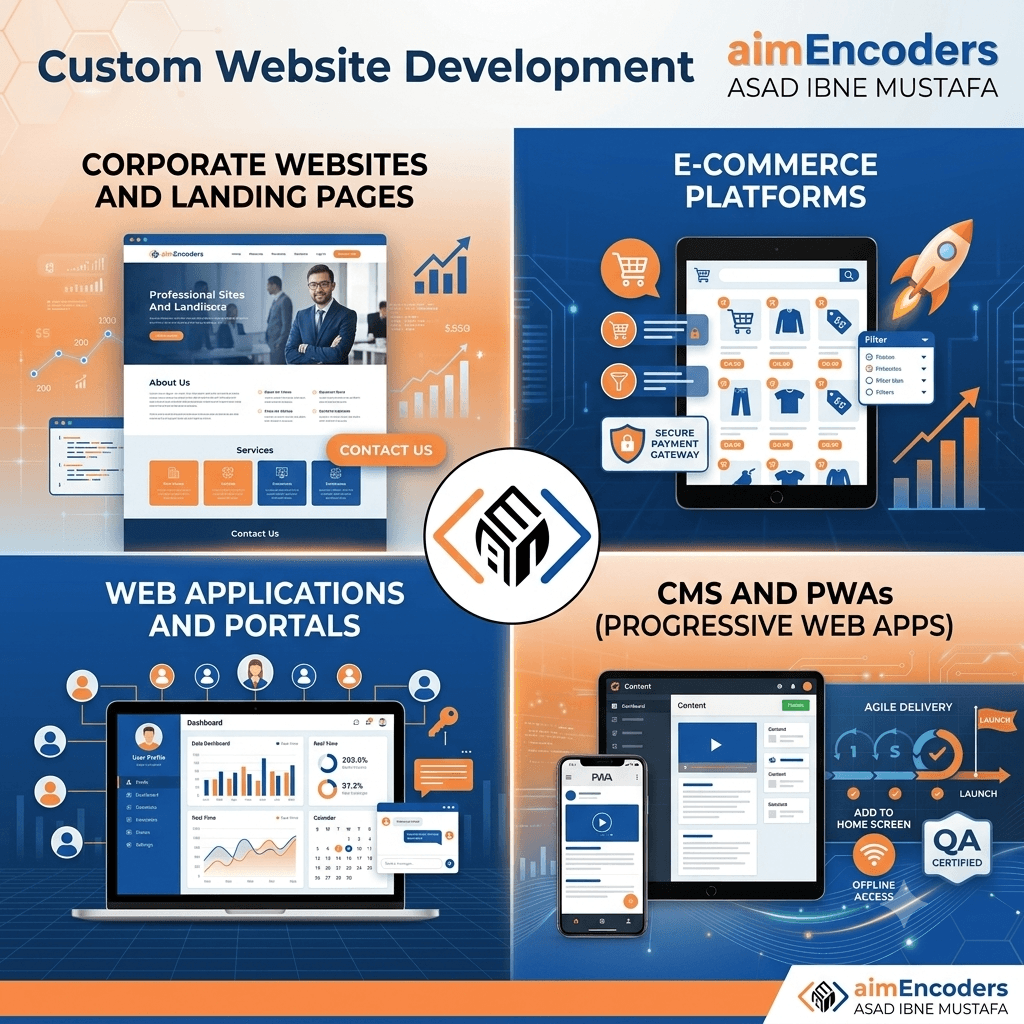
Progressive Web Apps: Bridging Mobile and Web in 2025
Your customers expect an app-like experience the moment they land on your site, whether they are browsing from a mid-range Android phone in Faisalabad or a desktop in Karachi. Progressive Web Apps (PWAs) are how modern website development teams deliver that experience without forcing users through an app store. For businesses across Pakistan weighing the cost of a native app against a mobile-friendly website, PWAs offer a compelling third path that blends the reach of the web with the polish of a mobile app.
Quick Answer: A Progressive Web App is a website built with modern web technologies that behaves like a native mobile app; it loads instantly, works offline, sends push notifications, and can be installed on a phone's home screen without an app store, making it a fast, affordable way to reach both mobile and web users from a single codebase.
What Is a Progressive Web App?
A PWA is a website enhanced with a service worker (a background script) and a web app manifest (a configuration file). Together, these let your site cache content, run offline, and be "installed" onto a device just like an app downloaded from Google Play or the App Store. The user visits a URL, taps "Add to Home Screen," and from then on your product looks and feels like a dedicated app, complete with an icon, a splash screen, and full-screen display.
Crucially, you build it once and it runs everywhere: Android, iOS, Windows, macOS, and any modern browser. That single-codebase efficiency is why PWAs have moved from a niche technique to a mainstream choice in professional web development projects.
PWA vs. Native App vs. Traditional Website
- Traditional website: Easy to reach and index by search engines, but slow on poor connections and unable to work offline or send notifications.
- Native app: Powerful and deeply integrated with the device, but expensive to build twice (iOS and Android), subject to app-store approval, and dependent on users choosing to download it.
- PWA: Combines the discoverability of the web with the speed, offline capability, and installability of an app, from one codebase and one deployment.
Why PWAs Matter for the Pakistani Market
Pakistan is a mobile-first country. The majority of users access the internet through smartphones, often on 3G or patchy 4G connections and with limited data plans and device storage. These realities make PWAs especially valuable here.
- Low data usage: Once cached, a PWA reloads with minimal data, which matters when every megabyte counts.
- No storage barrier: Many users hesitate to download a 50MB+ app on a device that is already low on space. A PWA installs in a fraction of that footprint.
- Works on slow networks: Service workers let content load from cache instantly, then update in the background when connectivity improves.
- Instant reach: No app-store gatekeeping means your product is one link away for a customer in Lahore, Islamabad, or Faisalabad.
For businesses that would otherwise lose visitors to slow load times or download friction, this can directly affect conversions. At aimEncoders, we have seen marked improvements in mobile engagement after converting client sites to PWAs.
The Core Benefits of Going Progressive
Speed and Performance
PWAs use caching strategies and lazy loading to deliver near-instant page loads. Faster sites keep users engaged and reduce bounce rates, and speed is also a confirmed ranking signal, so a well-built PWA supports both user experience and search performance.
Offline and Unreliable-Network Resilience
The service worker caches key assets so your app remains usable when the connection drops entirely. Users can browse previously loaded content, queue actions, and sync automatically once they are back online, which is a genuine differentiator for customers commuting or working in areas with spotty coverage.
Re-Engagement Through Push Notifications
Web push notifications let you bring users back with order updates, offers, or reminders, the same re-engagement lever native apps rely on, without requiring a store download. This is a big reason PWAs are transforming how companies stay in touch with clients, a theme we explore in how mobile apps are transforming client engagement.
SEO and Discoverability
Unlike native apps locked behind stores, PWAs are fully indexable by Google. Every page has a URL, can be crawled, and can rank, giving you the discoverability of a website with the experience of an app. Pairing a PWA with strong Answer Engine Optimization ensures both search engines and AI assistants can surface your content.
Lower Cost of Ownership
Because you maintain one codebase instead of separate iOS, Android, and web projects, development and maintenance costs drop significantly, an important advantage for startups and SMEs across Pakistan working with focused budgets.
Not sure whether a PWA, a native app, or a custom website is the right fit for your goals? Book a free strategy call with aimEncoders and we will map the most cost-effective path for your business.
How to Build a Progressive Web App
Delivering a production-grade PWA involves more than flipping a switch. Here is the practical roadmap our team follows.
- Start with a responsive, mobile-first foundation. A PWA is only as good as the website underneath it, so clean, responsive front-end code comes first.
- Add a web app manifest. This JSON file defines your app's name, icons, theme colors, and display mode so it installs cleanly on the home screen.
- Register a service worker. This is the engine behind offline support, caching, and background sync. Choosing the right caching strategy (cache-first, network-first, or stale-while-revalidate) per resource is where real expertise matters.
- Serve everything over HTTPS. PWAs require a secure connection, which also protects your users and supports SEO.
- Implement push notifications thoughtfully. Ask permission at the right moment and send value, not spam.
- Test on real, low-end devices and slow networks. Lab conditions rarely reflect a budget Android phone on a weak signal, which is your real audience.
Modern frameworks and build tools make much of this achievable, but the difference between a checkbox PWA and one that genuinely delights users lies in performance budgets, caching discipline, and thorough testing. This connects closely to the broader shift toward AI-powered web development and leaner, faster architectures like serverless.
Common Pitfalls to Avoid
- Over-caching: Aggressive caching without a proper update strategy leaves users staring at stale content. Plan your cache invalidation from day one.
- Ignoring iOS quirks: Apple's support for PWAs has historically lagged Android's; test push notifications and installability specifically on iPhones.
- Treating the PWA as an afterthought: Bolting service workers onto a slow, bloated site produces a slow, bloated app. Performance is foundational, not optional.
- Poor onboarding to installation: Many users do not know they can install your PWA. A subtle, well-timed install prompt dramatically increases adoption.
Is a PWA Right for Your Business?
PWAs shine for content sites, e-commerce stores, booking platforms, dashboards, and any product where reach, speed, and re-engagement matter more than deep hardware integration. If you need heavy access to device features such as advanced Bluetooth, complex background processing, or app-store monetization, a native build (or a hybrid approach) may still be warranted, and our mobile app development team can advise on the trade-offs.
For most businesses in Faisalabad, Lahore, Karachi, and beyond, a PWA delivers the largest share of app-like value at the lowest cost and fastest time to market. Explore how we serve clients through our locations, including our home base in Faisalabad and our growing client roster in Lahore.
Frequently Asked Questions
Do Progressive Web Apps work on iPhones?
Yes. PWAs run on iOS through Safari and can be added to the home screen. Apple's support has historically trailed Android's, particularly for push notifications, but recent iOS versions have closed much of the gap. We always test PWA features specifically on iPhones before launch.
Are PWAs cheaper than building a native mobile app?
Generally, yes. Because a PWA uses a single codebase that runs across web, Android, and iOS, you avoid building and maintaining two or more separate native apps. This typically means lower upfront development costs and reduced ongoing maintenance, which is why many Pakistani SMEs start with a PWA.
Can a Progressive Web App be found on Google?
Absolutely. Unlike native apps hidden inside app stores, every PWA page has a URL that Google can crawl and rank. This makes PWAs excellent for SEO and for discoverability through AI answer engines, especially when paired with a solid content and AEO strategy.
How long does it take to build a PWA?
It depends on scope. Converting an existing well-built website into a PWA can take a few weeks, while a full custom PWA with offline sync, notifications, and complex features takes longer. The best way to get an accurate timeline is to discuss your goals with our team.
Ready to give your customers an app-like experience without the app-store friction? Book a free strategy call with aimEncoders and let our team design a Progressive Web App that loads fast, works offline, and turns visitors into loyal customers across Pakistan and beyond.